I am terribly cynical about the Chinese protests. These Chinese people may be doing it out of a misguided sense of patriotism, but these protests are at best pointless, at worst highly disruptive. These mobs attack anything from Japanese restaurants (run by Chinese citizens) to Japanese cars (owned by Chinese citizens, made by Chinese workers, in Chinese factories) to random Japanese citizens (this is just criminal assault). I condemn the actions of these Chinese mobs - no, let me go further (just to provoke my dad), I am disgusted by the actions of the Chinese people and I do not want to be in any way associated with this kind of uncivilized, barbaric behaviour. My dad has said some pretty awful anti-Japanese rhetoric, but hey, I know just how incredibly racist he is. Whilst I can't change his mind, I can still annoy him by disagreeing with him - I can really wind him up when I tell him he is wrong!
 |
| The disputed Senkaku/Diaoyu Islands |
What is the bloody point of smashing up property that belongs to fellow Chinese citizens? Imagine the poor Chinese man who finds his car smashed to pieces by the mob just because it has a Japanese brand? Or the owner of the sushi restaurant who finds his livelihood destroyed? Did these crazy mobs ever think about the victims of their actions - especially when their victims are Chinese, rather than Japanese? This shows that these mobs are not thinking, they are just running mad with anger and are doing their cause far more harm than good. In harming fellow Chinese citizens, they are cutting off their thumbs to spite their hands - it is an act of such intense stupidity.
As a result of all these riots, many Japanese businesses and factories have suspended their operations as a result - what about the thousands of Chinese workers who depend on these factories for a living? Who is going to pay them if they are unable to work because of the riots? Are the rioters willing to compensate those workers who have not been able to work as a result of these riots? Of course not, they are just thinking about their own feelings on the issue - they have not spared a thought for the other fellow Chinese people whom they are harming with their thoughtless actions.
Why do I so resolutely condemn these riots? I believe that this is a terrible way to show your patriotism. Such is the difference between love and hate. If you're trying to show your patriotism, your love for China, then that is exactly what you must demonstrate: your love for China. Showing that you hate Japan or America or any other entity doesn't demonstrate your love for China - it just shows that you're a hateful person with a lot of anger. Let me show you how this works in practice.
I was once confronted by a PRC who accused me of not showing enough pride in my cultural roots given that my first language is English and not Mandarin and my cultural choices are often not Chinese: for example, I prefer K-pop to Mandopop. Plenty of K-pop on my iPod but not a single Chinese song. I explained to him that just because I don't have to hate Korean music or the English language to express my love for Chinese culture. I then talked about the times I have spent in China, the things I have encountered in China and the aspects of Chinese culture that I do love - then I realized, this PRC person has been so busy hating and rejecting everything foreign that he hasn't really taken the time to appreciate his own culture. Despite being from China, he was actually unfamiliar with many of the things I had talked about in his country. I then told him that it was ironic that for someone who claims to be patriotic, he should be ignorant of so many aspects of China's rich cultural traditions. Guess how he reacted? He said, "I am so patriotic: I hate Japan! I hate America! I hate Britain! I hate white people! And I fucking hate you Singaporeans too!" Groan. He just didn't get it and I realized there was no way I could change his mind.
 |
| Do you know the difference between love & hate? |
Maybe it's just the way I am - I choose to express love with love. I don't choose to express love with something quite the opposite, that's just my character. Why are these Chinese people so misguided by thinking that they can use anything but love to express love? Why do some people may think they feel love but they come up with a course of action that suggests quite the contrary? We need to hold people responsible for their actions - rather than excuse them for any mistakes made on the basis that they had the right motivations. It boils down to the fact that there is the right way to express your feelings and a very wrong, very disruptive, very counter-productive way to do so. Is this a uniquely Chinese situation? No, it is a fallacy that befalls all human beings. I view suicide bombers in the same manner - they think their motivations justifies their action, no matter how horrific or how little it actually serves to help their course - but they are so delusional that they are willing to blow themselves up and kill loads of innocent people in the process.
I have had a close brush with suicide bombers myself - being a Londoner, I was actually on a Piccadilly line train near Green Park the moment one of the suicide bombers blew himself up on a train between Kings Cross and Russell Square. I could've been blown up that day - 56 people died that day and over 700 were injured. I don't think anyone in London will ever forget where they were or what they did that morning - it was our 9/11.
I can understand why some Muslims can hate my country's foreign policy, I can see how Britain's actions in Iraq and Afghanistan has made us so many enemies. However, I was deeply against the war in Iraq and Afghanistan. I didn't vote for the the Labour government who took us to war, I even went on anti-war peaceful demonstrations to protest against British involvement in Iraq. I am clearly on the side of the Muslims who feel aggrieved at British foreign policy in the Middle East - yet I could've so easily been killed that day indiscriminately. Indeed, amongst the 56 who died were several Muslims - that was how random and pointless the killings of suicide bombings were on that day.
Let's look at the other side of the equation for a moment - are there any anti-Chinese demonstrations on the streets of Japan? Well, yes there are a number of peaceful demonstrations by Japanese nationalists - but none of these protests have turned violent. They were dignified and political - it wasn't a violent rampage through the town, attacking innocent people. Have a look at the youtube video below of an anti-China protest in Japan from 2010. Why aren't the Japanese reacting quite as passionately as the Chinese over the issue? I suspect it is because the vast majority of Japanese people don't have an axe to grind with the Chinese - whether or not Senkaku/Diaoyu Islands belong to Japan or not doesn't have an impact on their everyday lives. They are far more concerned with their jobs, their families, their healthcare, how much tax they pay and other things that concern them directly. Quite frankly, the same principle applies to the Chinese people who are out on the streets protesting - it wouldn't make the slightest difference to their lives if the Japanese relinquished all claims to Senkaku/Diaoyu today.
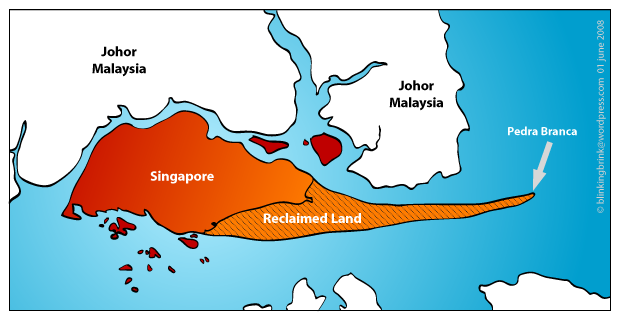
Let's look at something a little bit closer to come: the Pedra Branca lighthouse dispute between Singapore and Malaysia. It took a good 29 years for it to be resolved (from 1979 to 2008) at the International Court of Justice at The Hague (Netherlands). Sure, some strong words were traded between the two countries but nonetheless, both countries did behave honourably towards each other - why? Because we realized that the outcome wasn't going to affect our everyday lives either way. The two countries recognized that they were neighbours and had to get along either way.
 |
| What should Singapore do with Pedra Branca? |
Now in the case of Japan and China - some people have pointed out to me that Japan still hasn't really (or sufficiently) admitted to the war crimes committed in China during WW2, such as the rape of Nanjing. In fact, there are some today who even deny that it ever happened or disagree with the facts of the case. I have in fact interviewed a Japanese historian earlier this year to try to understand the Japanese perspective on this. Well, I beg to differ. Racist Chinese people like dad will always assume the very worst of Japanese people and such nasty Japanese people who deny the the rape of Nanjing do exist, but they are in the minority. There are many Japanese people are completely aware of their country's war crimes during WW2 whilst some are simply ignorant of history - but there is a difference between ignorance and actively hating China. Of course, the Japanese government can always do more to show more contrition over WW2 and improve diplomatic relations with China, but shouldn't the Chinese protesters be directing their anger at the Japanese government rather than the entire nation of Japan per se?
Of course people should have a forum to air their opinions, but who should we direct our anger and feelings at? Peaceful protests should be allowed, for citizens to make a point in an organized way - for example, in front of the embassy of the country you have an issue with. During the last days of the way in Libya, I did join many Libyans and anti-Gadaffi protesters in front of the Libyan embassy at Hyde Park Corner here in London. I have also joined various protests in front of many embassies - from the Saudi Arabian embassy to the American to the Burmese embassy. But note, there is a big difference between a well organized, peaceful protest to make a point and just running amok in the streets, attacking completely innocent people.
The news today from Pakistan provided a good example of this kind of protests which turned scarily violent. 19 dead today as violence spreads across Pakistan. As you would have read in the news, some nutter in America made an anti-Islam video and uploaded it to Youtube back in July. The Pakistani protesters were not able to attack the US embassy because it was very well guarded, so what did they do? They attacked cinemas. That's right, they were angry with the film, so they vented their anger on cinemas - cinemas owned by Pakistanis, run by Pakistanis, not Americans. Honestly, how would you feel if you were an innocent Pakistani person who worked in a cinema and you got attacked out of the blue like that?
In any case, this anti-Islamic video was made by one person - and guess what? He isn't even American - he just lives in America. Meet Nakoula Basseley Nakoula, an Egyptian-born Coptic Christian living in California. Good grief, salah lah. He's Egyptian, not American. But heck, these are just details that the mob is not interested in. One gets the feeling that these people are angry anyway and are looking for any excuse to go rampaging. Is this about patriotism, religion or simply an excuse for frustrated people to vent their anger?
The situation in Pakistan and China do share one thing in common - the people are angry with an external enemy and the governments are allowing the people to protest about it. I am cynical about the reasons why the governments are publicly endorsing such protests. There is a lot of dissatisfaction with the governments of both countries amongst their people: the growing wealth gap and corruption in government are the two biggest, unresolved problems facing both countries. Neither the Chinese nor the Pakistani government have any easy solutions to these complex problems - but if they can distract the people with tactics like, "ooh look at the nasty enemy, aren't they terrible and evil, they have insulted us. Yeah let's all get angry with Japan/USA", then the people forget (at least for a while) that they actually are angry with their own government. It's a diversion, a distraction.
Perhaps one good thing can come out of this in the case of China. The last time we saw such huge protests in China was during Tiananmen square protests of 1989 which were brutally suppressed with up to 6,000 civilians killed. Since then, the Chinese government has brutally suppressed any kind of demonstration (however small) to avoid a repeat of 1989 Tiananmen. Anyone who tries to speak up against the government would be arrested and punished. Misguided as they may seem, these protests are actually giving Chinese people a first taste of what it is like to have their voices heard. Yes, it's called freedom of speech, it's something we enjoy in democracies.
23 years ago, the world watched on in horror as the Chinese authorities cracked down on the Tiananmen protestors - the overwhelming sympathy was for the prosteters and the Chinese state looked cruel and brutal in comparison. Today, under the glare of the international media, this current generation of Chinese protesters simply made themselves look very bad and will be scaring away international investors and tourists. When I watch the videos on the news, I actually feel sorry for the policemen given the difficult task of trying to police these violent riots.
The big difference between then and now is the transformation of China from a socialist economy to the world's second biggest capitalist economy. Have a look at the photo below and you will be able to see the transformation in the Shanghai skyline from 1990 to 2010. The facts speak for themselves: China's economic miracle in the last 25 years has dazzled the world - yet there is still this lingering sense of insecurity amongst many Chinese people when they wonder if the rest of the world actually recognizes their new economic power as if they are still not quite used to their new status as a world economic superpower.
 |
| Shanghai: 1990 vs 2010 |
My Scottish friend Mark who speaks Mandarin fluently has travelled extensively in China - he told me, "The most common questions the Chinese people ask me are: do white people still 瞧不起 and 小看 ("look down on") Chinese people? Are they aware of the Chinese economic miracle? Do they still think of China as a poor country today? These questions are even asked by Chinese people who are far richer than me - yet are millionaires, yet they are so insecure. They worry that if they are not dripping with gold and diamonds or driving a Porsche when they show up in New York or London, they would be perceived as a poor Chinese peasant. The fact is, whilst there are many rich people in China today, there are still many poor Chinese people trapped in poverty, working in the factories or farms for very little money. The rich Chinese people are terrified of being mistaken to be poor and they would go out of their way to tell me how rich they are - I just can't imagine rich people in the West boasting about their wealth like that."
Could this insecurity account for this tone of the current wave of anti-Japanese protests? Are they flexing their muscles at the Japanese because they think that the Japanese are not afraid of China or even look down on China? Are they acting out of insecurity because they are afraid of not being given the kind of respect they deserve? Mind you, this is a very human instinct - let me give you an example of how I found myself in this position last night.
 |
| Do Chinese people have a self-image problem? |
I cycle in London - it is a cheap and efficient way to get around the city but we don't have enough cycle lanes and we often have to share the road with the traffic. I would always cycle next to the kerb, rather than in the middle of the busy traffic. As I was passing approaching a hotel, I saw a young doorman (about 18, 19 years old) hail a taxi in front of me and the taxi pulled up by the hotel. The doorman then held the door open as an elderly couple took walked slowly from the hotel's front door to the taxi. Now the doorman could've closed the door and let me pass on the inside (there was space, the taxi wasn't that close to the kerb) and only opened it for the elderly couple (they were walking slowly) after I have passed. But no, he held the door open and effectively blocked me. I could swerve to the right of the taxi but I didn't want to risk changing lanes at the last minute as the cars in the middle lane were going a lot faster.
So I made a judgement call and stopped. I asked him, "Could you let me pass please?" And he looked quite annoyed and with an air of self-importance, he turned to me and said, "One moment, I have to open the door of the taxi," as he continued to hold the door open for the elderly couple (who were at that stage still no where near the taxi). Now I could've raised my voice at him and got quite nasty. In fact, there was a part of me that wanted to cycle right up to the taxi door and park myself right in front of the taxi door and then bark at him, "Now you know how it feels for someone to deliberately get in your way. How does it feel to be earning minimum wage boy doing shit like this? Are you proud of what you do? Your parents must be so disappointed seeing you do a job like this. I bet they wanted you to go to university and get a proper job, like become a doctor or lawyer."
 |
| Hotel staff in London are mostly on minimum wage. |
But no, I didn't. Yes he was being very inconsiderate, but what would I have achieved by insulting him? Calling someone stupid doesn't make you any cleverer. Calling someone ugly doesn't make you any more beautiful. Calling someone poor doesn't make you any richer. I would have been acting out of insecurity, out of a fear that he didn't respect me, that he wasn't giving me the due respect I deserved as a cyclist. Sure I was angry with him, but I decided to simply check that the pavement was clear and I mounted the pavement to overtake the taxi on the left. If this guy wanted to pretend that his job was so important, well that's his problem not mine. He knows his position in society and is reminded each time he receives his pay check as he is reminded that he is paid the minimum wage. Yes I was frustrated but I didn't need to vent my anger on him. I could've said so many nasty, cruel things, but I chose to rise above it - that doorman's stupid and inconsiderate behaviour was his problem. I wasn't going to let it become my problem by allowing him to upset me.
Yes the Chinese people are frustrated with the provocative actions of a small number of Japanese nationalists who landed on Senkaku/Diaoyu Islands and planted their flags there - but I see a massive lack of self-control in the way the Chinese people have allowed their feelings to explode in violent behaviour. This is not right, particularly when innocent Chinese people are harmed in the process. Indeed, in the words of Satoru Mizushima, the organizer of a Japanese nationalist rally, “Let’s show the Chinese that we are much more sophisticated than them by demonstrating in an orderly manner, with enthusiasm." There is so much value in keeping our feelings in check, in thinking before we lash out - that is what makes us a civilized society. Such is the difference between a gentleman and a barbarian.
It could've been a golden opportunity for China to move towards a more open society, embracing freedom of speech in small steps, but sadly, it seems that they have foolishly squandered this opportunity. What do you think should be done? What is your reaction to this dispute? As usual, leave a comment below and let me know what you think. Thanks.
Hi LIFT,
ReplyDelete> it is easy to unite a troubled nation when there is an external threat for the people to focus their frustrations on.
My ex-PRC housemates (now Canadian passport holders) were discussing the matter the last few days. In their opinion, the anti-Japan riots are a big wayang co-ordinated by the CCP to distract attention from the Bo Xilai issue (verdict due on coming Monday). Quoting BBC, "Mr Bo, Mr Wang's former boss in Chongqing, had been tipped for promotion to the top leadership ranks at the party congress before his downfall."
http://www.bbc.co.uk/news/world-asia-china-19671444
In fact, there is even speculation that the Japaneses' landing, the Chinese riots and the diplomatic fall-out thereafter is a co-ordinated effort between politicians on both sides who desperately needed some distraction from their own internal problems. Politics is one big show.
Cheers, WD.
Yup, totally true - but how do people allow themselves to be manipulated like that? After all, virtually all Chinese/Japanese people would never set foot on Senkaku/Diaoyu islands and even if they were some kind of oil or gas deposits near the islands, it's not like they were ever going to personally benefit from it.
DeleteIt's like .... I'm a British citizen and we have oil reserves in the North Sea ... soooo? It's not like I have my own oil well just because I am British! The fact that oil/gas reserves exists within my country is quite frankly irrelevant, yeah some people benefit from it, not me though.
Keep the masses under-educated, unemployed/under-employed, poor and hungry, and you can get them to do anything as a politician. A bit of money to employ people to rally to the protest would also help. Link below is an example from Russia, but it happens in many countries with a significant mass of the under-educated, unemployed/under-employed, poor and hungry folks.
DeleteQuote, "NTV aired a controversial documentary earlier this year that alleged protesters had been paid "cookies and money" to attend last winter's "For Fair Elections" rallies."
http://en.rian.ru/russia/20120506/173266773.html
Unevolved and barbaric, that's my view on violent protests. I don't actually think most of these rioting Chinese care much about the border dispute; it's a convenient excuse to let loose their ugly selfish side, to me, destroying the property of others is borne from petty jealousy of others' success, and looting stems from greed.
ReplyDeleteThe more civilised countries have moved beyond such behaviour and protests are organised and peaceful. Clearly the people are making their point, and if the government ignores them, we'll see who quakes in their pants come next election. Peaceful protests do work, I believe.
Despite the economical miracle of China, the people have not grown much socially. In a way similar to Singaporeans. There is this survival-mode permeating the society, it's still "you die, that's your problem", of selfishness and lack of social graces. They have the cultural revolution to put the blame on, but what's our excuse I wonder. Oh well. The day Singaporeans is allowed and can be bothered to have even a peaceful protest. That will be the day.
Or would we be more interested in a looting riot? Free shit leh.
Totally!!! I so totally agree with you!!
DeleteI do agree that it seems like a situation where the politicians of both sides wag the dog to detract from bad domestic news and issues.
ReplyDeleteHowever, the riots in the UK also arose from a disaffected populace. I think the situation in China is similar. It's just an excuse for people to vent their unhappiness and mobs usually get violent. Anyway, I think there is a greater chance of armed conflict from the Spratly Islands.
I read in a FT Chinese story (it's been taken off for some reason, but you can try googling for “日本媒体眼中的钓鱼岛危机”) that some Japanese are actually quietly hoping the silly Chinese will continue doing what they have been doing - wrecking cars and shopfronts, fighting their own police (& fellow PRCs for driving Japanese cars), and just being a nuisance.
ReplyDeleteThis will just help to perpetuate the already negative reputation of the Chinese with the rest of the world. As it is, other than Chinese nationals and older Chinese around the world (like your dad) with strong Chinese sympathies, I think most do not think well of the Chinese way of going about it.
And if it ever comes down to a reasoned (although this seems pretty unlikely) resolution, say through the international courts, guess who will come out of it the winner.
Totally, good point. Such disputes are never resolved via violent protests - short of going to war with the other country and invade the disputed territories like what Argentina did with the Falkland islands in 1982. That didn't end well for the Argentines, did it?!
DeleteSuch border disputes can only be resolved through the International Court of Justice in the Hague (Netherlands) - such as the case of Pedra Branca. Both countries need to just keep calm and allow the dispute to be resolved, a process which can take many years. I believe S'pore and M'sia have set an excellent example of "keep calm and carry on whilst this is being resolved".
I think the Chinese are kinda worried, and therefore resisting the idea of going to the international courts, partly because of the Singapore-Malaysia example. Apparently, the ICJ does not lend too much of a weightage to the historical argument. Not to say that it is not important, but the more recent 'ownership' (with / without dispute) of the territory does come into play a lot more from the legal perspective.
DeleteAlso, the typical Chinese way lah... they think they shout louder means the whole world will just accept their argument. Good f**king luck to them. hahaha
On a personal level, Malaysia taking control of Pedra Branca wouldn't affect ordinary Singaporeans' lives. However, it is said that Singapore was concerned that if Malaysia has sovereignty over Pedra Branca, the latter will control the waters surrounding it and block ships from entering Singapore's ports through those waters.
ReplyDeleteThe fact remains though, that whilst some strong words were traded between S'pore & M'sia, it didn't go beyond the usual verbal insults. There were no riots in the streets of Singapore or KL - we behaved with a lot more dignity in both S'pore & M'sia.
Delete