But onto thisismyvoice's question, I am happy to summarize for you what I shared with the BBC - I did go try to get as much as I possibly could out to the BBC journalist but needless to say (gosh I blog about this, a lot), because the article featured 20 interviewees, my long story was trimmed to just one measly paragraph! So allow me to give you ten bullet points about what was edited away - this is a great idea, thanks thisismyvoice!
 |
| My panda Bui at BBC Media City last year. |
1. I went into more details about why I had no faith in the Singaporean government despite Singapore's economic success over the last 50 years. I did take the time to talk about Singapore's economic transition from a third world country at the time of independence to the world's third richest country in 2013. I don't think any discussion about migrating to/from Singapore would be complete without paying heed to that transition which has a huge impact on the mindset of Singaporeans. In particular, most migrants typically move from a poorer country to a richer country (eg. from Kenya to Australia, from India to Canada, from Cambodia to Germany), but in my case, I was doing the opposite in settling in the UK which meant that I was not your typical migrant to the UK.
2. I discussed the very long and slow process it took for me to get my citizenship - how I first came as a scholar on a student visa and why it took that long for me to naturalize as a British citizen. I felt it was important to share that information as many people simply do not understand how you switch nationalities - it's a process that takes many, many years to change your status. Getting a British passport (or an American/French/German/Australian etc passport) however, is a process that is very, very slow - like watching paint dry.
 |
| British culture has wooed many to the UK over the years. |
3. I explained in a bit more detail why national service discriminated against Singaporean males - I suppose because some of the others also talked about national service as the primary motivation to give up their nationality, they didn't feel the need to elaborate on that point. I also explained how the CPF system works (employers' contribution) and why that puts locals at a disadvantage over foreign workers in Singapore who don't have CPF.
4. I talked about the difference between living in the UK as a Singaporean with "permanent leave to remain status"(the British equivalent of 'permanent resident' status in Singapore) and getting British citizenship. It was then deciding which passport would be more useful to me in the long run, for what I want to do: the UK passport was more useful as it would allow me to work anywhere in the EU with no restrictions. A Singaporean passport would mean having to get work visas and more restrictions if I wanted to work in any other country apart from the UK or Singapore.
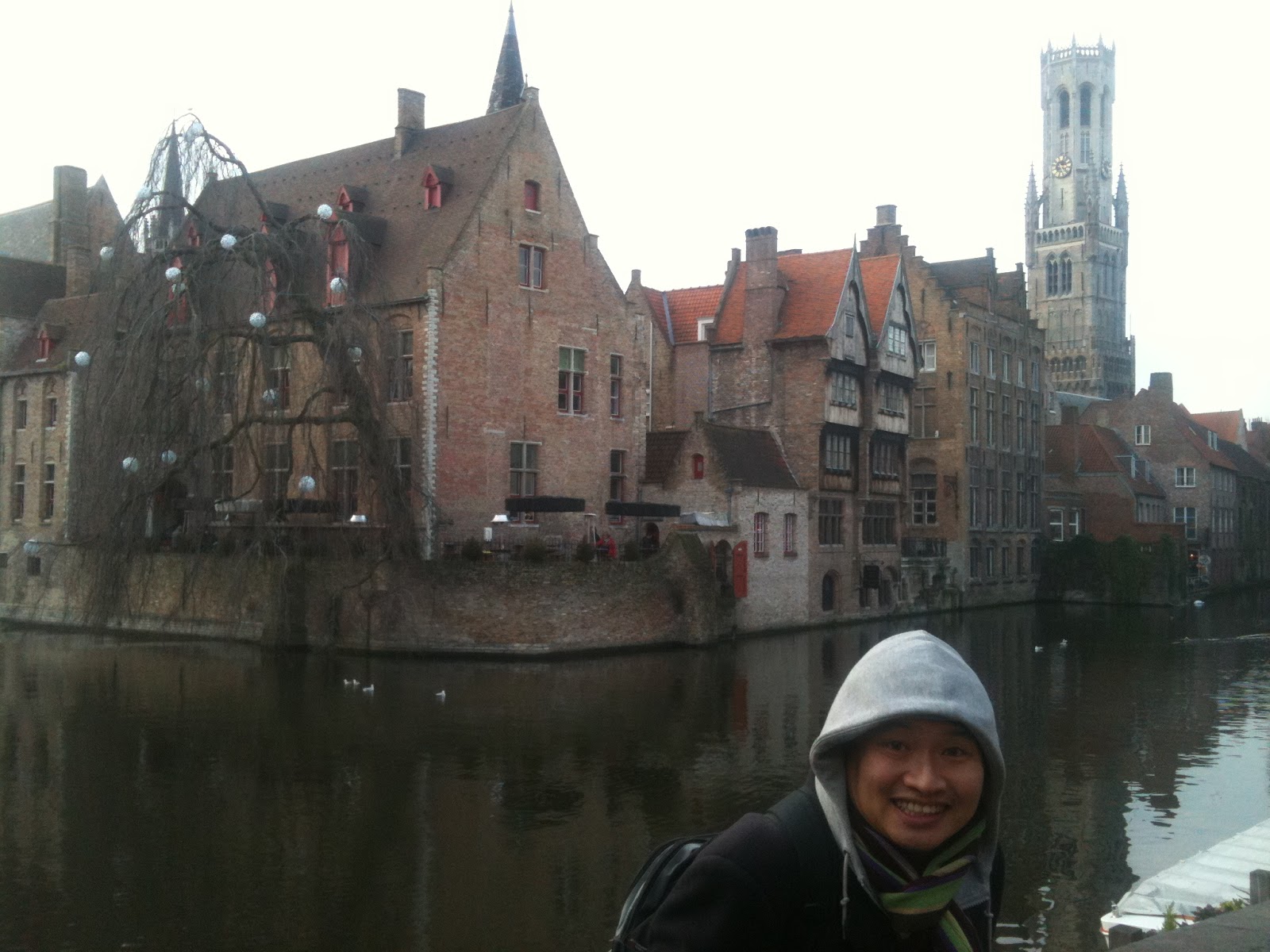 |
| I was working in Belgium earlier this year for a French company. |
5. Furthermore, a British passport would allow me to waltz into Singapore as an foreign talent and I would be treated far better as a British FT than a returning Singaporean given how the system in Singapore favours Brits over locals. Why would I work in Singapore as a Singaporean when I can work as an FT and enjoy better treatment by the system? The PAP loves FTs! #donthatetheplayerhatethegame So even with a British passport, I still have the option to return to Singapore to work if I want to (and on much better terms than a local).
6. I talked about how the Singaporean government is actively trying to grow the population in Singapore despite the land area being very limited - this has led to Singapore becoming far too overcrowded and the signs of strains are everywhere. There is such intense competition for school places, there is overcrowding on the public transport. property prices have been inflated and the population density is just becoming silly. And by the same token, life in the UK is just so much better, away from the madness of the overcrowding.
 |
| Would you like to be caught in that crowd? |
7. I explained why I didn't want to stay and fight the system - I realized from the start that I was in the minority. Most Singaporean voters (60.14% to be precise) are happy with the PAP and even if 40% of Singaporeans rejected this path the PAP has set the country on, there's virtually nothing they can do about the situation since 60% of Singaporeans have voted for the PAP. This is democracy in action, you may not like what is happening, but if you're in the minority, then what can you do? It sucks to be in the 40% with no hope of seeing change happen in my life time, so I had to leave. So it's not just the PAP per se, it was the 60.14% of Singaporeans I didn't like. There were many things about Singapore's society that I just didn't think would change quickly enough in my lifetime - from gay rights/section 377A to freedom of speech to the culture of conformity. If that's the way Singapore is and that's what Singaporeans want for themselves, fine - good for you - but it's not for me and it's not for me try to change you.
8. I also talked about the ideological differences between the way democracy works in the UK and how it works in Singapore. There are quite a lot of differences actually despite Singapore being a former British colony and having experienced both systems, I can tell you which one I think is better and prefer. (Please see my vlog piece below)
10. The journalist asked me if I considered holding on to my Singaporean passport (ie. have dual nationality), I said I could have held on to my Singaporean passport quietly after I had obtained my British passport, but that would be breaking the rules - Singaporean law does not permit dual nationality. I wanted to have the right to travel freely to Singapore to visit my family, to work, to go for business trips etc without worrying if I would be arrested for breaking the rules - so I 乖乖 gave up my Singaporean nationality within a few weeks of getting my British passport. I have Singaporean friends who have obtained a second nationality and told me that there was no way the authorities would find out about my British passport, but seeing that there was no way in hell I would ever want to live in Singapore as a Singaporean, there weren't really that many advantages to holding on to a Singaporean passport - apart from maybe travelling to certain countries like China, Vietnam and Indonesia without a visa (I need a visa for those countries with a British passport). The journalist asked me if I would consider dual nationality if the Singaporean government changed the rules - I said that it was a hypothetical question as I couldn't get it back now that I had voluntarily given it up.
 |
| The journalist asked me many interesting questions. |
So there you go, if the journalist was just interviewing me and no one else - then he could've included all of the above. But as I was just one of 20 interviewees, then only that one paragraph made it into the final article. The rest of the points covered here were edited out, unfortunately - but I am glad I am able to use my blog as a platform to share that with you. Thanks for the idea thisismyvoice! Let me know what you think, please leave a comment below.

Actually, i had to agree with your friends that you should have kept your sing passport quietly. One of my close relative holds both NZ and Sing citizenship and she worked as a scientist at one of the local uni. She told me that a lot of top talented foreign scientists here hold dual citizenships. The ICA keep a one eye closed or otherwise Singapore would lose these top foreign talents.
ReplyDeleteOf course, that would mean you have to keep your head low and would not have started this awesome blog.
Hahahahaha hindsight is 2020 lah and you're right if i had held on to my Singaporean passport and kept quiet about it, it would've been probably okay lah - but what good would it serve me (apart from visa free travel to some Asian countries)? The irony is that if i wanted to work in Singapore (which I did in 2011) I am sill always better off as a British FT than a local singaporean, so having to pay a bit of money for a visa when I am on holiday in Asia is a small inconvenience - that's the downside, compare that to the benefits of being able to work all across the EU visa free and to be welcomed in Singapore as an FT rather than a local with reservist obligations.
Deletefrom HWZ.
ReplyDeletehttp://forums.hardwarezone.com.sg/80127065-post18.html
" A 21yrs old fresh out of NS dude can predict what is gonna to happen more than a decade later? Invite him back to be PM pls. "
Kum siah, kum siah :) Uncle Limpeh just very ordinary person lah, i am an Ah Beng from AMK at the end of the day.
DeleteHi LIFT, Speaking for my fellow Singaporeans who are stuck in Singapore due to lack of skills or because we cannot afford to emigrate, our wish is for our children to be able to do so. The reality is that our children are not going to make it without our help. They are destined for a life of struggle & deprivation if they remain in Singapore.
ReplyDeleteThe alternative is to elect a more compassionate government but I am not optimistic that it can happen. Yesterday at the 3rd Hong Lim Park Population White Paper Protest, the blogger of "heart truths" said, judging by the attrition rate of support for the ruling party over the past 4-5 elections (including BEs & PE), 2016 could be a watershed year if the trend continues. Supposedly, 2011 was a watershed year too, but what has changed?
In any case -even if one day in the distant future (which some analysts predict will be another 3-4 GEs away) the PAP no longer holds an overwhelming majority of seats- given the many constraints on this small island, where most people will never own a car or a real house, I still cannot foresee a better life for Singaporeans, no matter which party is in power. Can you?
Hi Lam Toh, thanks for your comment. Just out of curiousity, where would you want to migrate to? I see two patterns emerging. The classic pattern is what I did - head to a country like US, UK, Oz, Canada, NZ etc. The other pattern I see is when Singaporeans go work in places like Thailand, Malaysia and other Asian countries and they stay there on a long term basis (like for 20 or 30 years) with little intention of returning to Singapore. The only difference is that those in the latter group are v unlikely to take on local citizenship, unlike the former group.
DeleteYou've hit the nail on the head about the future in Singapore - too many people, it's overcrowded, as the population races towards 6 million, how many more people do you want to squeeze onto this island? It then becomes the kind of place where the rich will always have a nice life, in their swanky condos and the poorer people in their HDB flats will be the ones who feel the squeeze.
Let me make a prediction: you will see a lot more of this happening in the future. As young married couples cannot afford to get their own accommodation (due to the rising property prices in Singapore), they will continue to live under the same roof with their parents. So whilst the government may dress that situation up as, "wah, look at these big happy Asian families,三代同堂" the average number of people per HDB flat will steadily increase and the amount of living space per individual will fall.
The other alternative is to get rid of the nature reserves and build flats there - but do we really want to get rid of what little greenery and forest cover there is left in Singapore? But how else are you going to accommodate everyone else then?
Like I said before, in places like New York, Paris, London etc - poor people can be driven out of the city, it is expensive to live in the big city but if you can afford it, you can have a good life. Where do you expect the poor people of Singapore to go? Johor? Does Malaysia even want them there?
The first 2 predictions are probably coming true faster than most imagine. After all, why else is the government constantly reiterating the rhetoric or dichotomy of 'stayer-quitter', if not for the fact that Singaporeans are leaving in larger numbers to study, work and live overseas?
DeleteAccording to what my godsis back in Singapore told me, one of the MPs actually suggested cutting down whatever trees and parks we have to make space for the new incoming population, as much as he loves greenery! This just shows how desperate the PAP is to get all the foreigners in at whatever costs.