1. The reduced counter
Not to be confused with a sale. This is when a supermarket would offer a discount on produce that is nearing its expiry date. So for example, if today is the 27th September and the product has a "used by 27 September" sticker on it, then by about 5 pm - they would start slashing the prices. Maybe in the early evening, you may get 20-30% off but if it still unsold after 8 pm, then you could get like 70-80% off and if it is nearly closing time, they would sell it for a ridiculous price like £0.10. That is why I love going to the supermarket in the evening, just before making my dinner because I know I can usually pick up something on reduced.
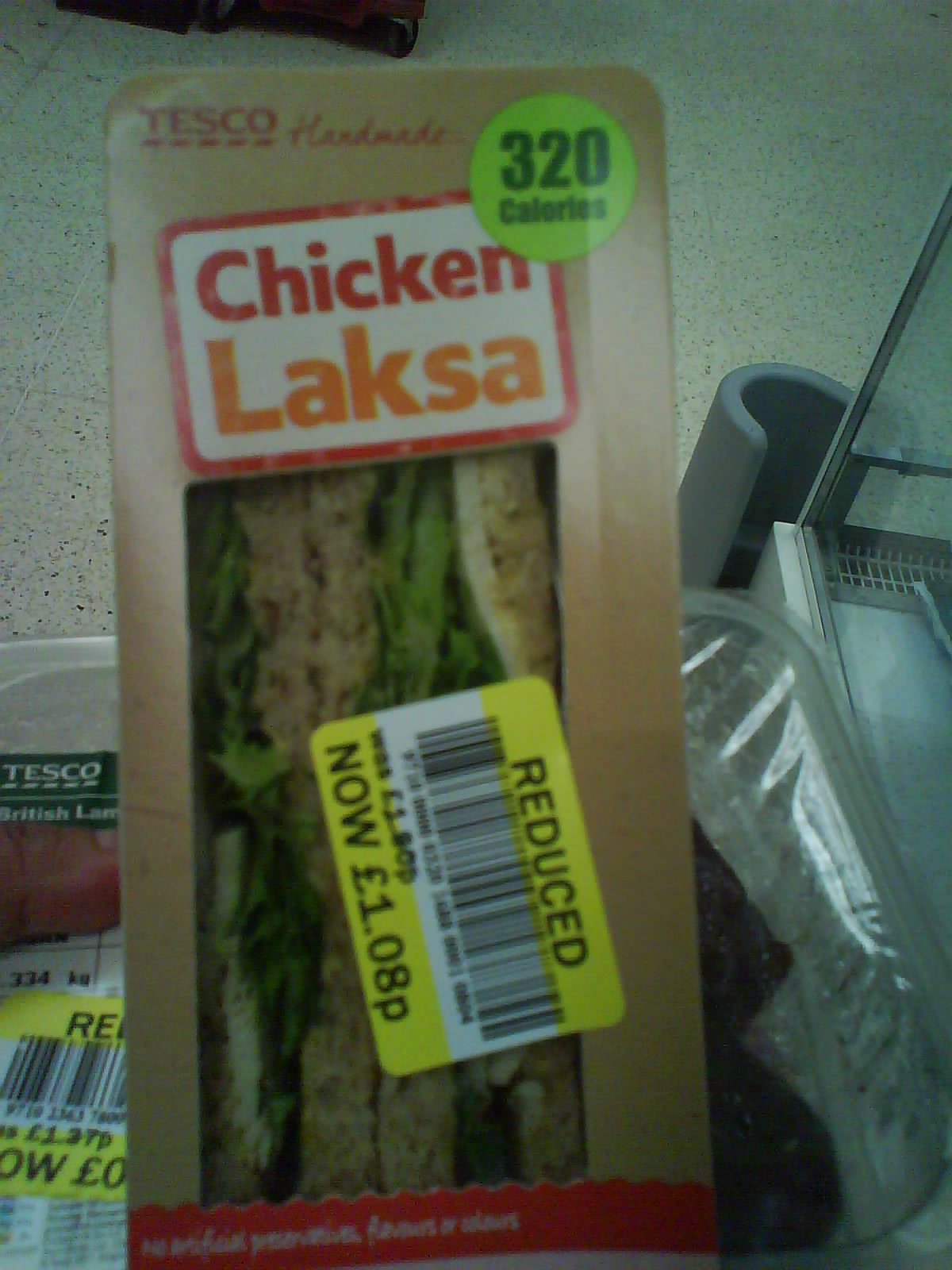 |
| That's a Laska sandwich on reduced. LOL. |
You will never find food that is past its sell-by date in a supermarket - that would be illegal for the supermarket to try to sell food in that state. So it is perfectly safe to buy this discounted food from the reduced counter as long as you either cook it the moment you get home or freeze it. Everyone loves a bargain and there are bakeries that offer massive discounts on their produce near closing time as they do not keep the good overnight - they will bake everything fresh the next day so they need to get rid of the stock. They'd rather get a bit of money for it than to throw it into the bin.
Now the only place in Singapore where I have encountered this are the sushi joints - where you can pick up heavily discounted sushi at closing time. But they don't tend to do this with everything else though.
 |
| Yay! Sushi sale! Lelong lelong! |
Verdict: Oh yes, go for it. Totally. It's a great way to pick up a bargain.
PS. Yes you can get discounted sushi too in Britain, but only get sushi from shops that specialize in sushi like Wasabi, Yoshino, Yo Sushi, Itsu Sushi, Moshi Moshi sushi etc. If a shop makes sushi and nothing else, it will almost certainly be excellent. But if you get sushi from a supermarket like Sainsbury, M&S or Tesco, it's likely to be terrible.
2. Charity shops
For those of you unfamiliar with the concept, here's how it works: basically you have a shop which is run by a charity - they accept donations (mostly second hand books, clothes, shoes, CDs, DVDs, anything really) and they sell these donations to the public in the charity shop. The money raised goes to the charity and it is fairly common in any British high street. I often donate my old stuff to charity shops rather than throwing them away, so I know I will be doing some good in the process.
 |
| A typical British charity shop |
Verdict: I would definitely encourage you to donate stuff you don't need to the charity shops - allow them to raise some money for a good cause! But would I buy stuff from charity shops? I wouldn't really buy clothes from there, but other stuff like plates, DVDs, books and other stuff like that, why not? I remember when I needed some plates as a student, I managed to pick up a set for less than £2 - not only did I get a bargain, I knew that money was going to charity! Pretty cool, eh?
3. Asian vs Oriental
Oh this is still irritates the tits off me. I am Asian because I was born in Singapore and my ancestors can be traced back to China, which is also in the continent of Asia - but in the UK, when you describe yourself as Asian, that tends to mean you are from the South-Asian sub-continent: India, Sri Lanka, Pakistan, Bangladesh and Nepal. The word they would use to describe someone like me is either Chinese or Oriental (which would mean 'East Asian': Korean, Japanese, Chinese, Vietnamese, Mongolian etc)
 |
| Are you Asian or are you oriental? |
Now in America, they would have no problem classifying someone of my ethnic origin as Asian and I grew up in Singapore happily using the label Asian to describe myself so I have always been really resistant to accept that I can't use that word in the UK without making people think I am Indian. I find the word 'oriental' somewhat strange as it means something different in American English as well - I don't feel comfortable with the term 'Chinese' as I don't want to be mistaken as someone who actually was born & bred in China. I feel uneasy with the term Singaporean as well as it tends to mean someone with Singaporean nationality (I have a British passport and have been British for many years) - so I really prefer the vague term Asian (ie. from the continent of Asia) - but no, I can't use that here. Grrr.
Verdict: Just be aware of the difference and the different way people use the term 'Asian'.
4. Cycling
Whilst people in Britain don't cycle as much as say in Holland, Belgium or Germany, you will find many more cyclists on the roads than in Singapore. This is primarily because of the weather - when it is 11 degrees, it is absolutely glorious to cycle. You get some exercise and it is often cheaper than public transport. There are usually cycle lanes on some major routes and often, during rush hours, you can see the cyclists moving in packs (safety in numbers I say) through the rush hour traffic. I wouldn't want to cycle in Singapore - it's just too bloody hot. I don't want to arrive in a client's office dripping with sweat because I have just cycled 5 km in the midday heat.
5. The great outdoors
Relating to the previous point on cycling, the Brits have a much greater appreciation for being outdoors than Singaporeans. Again, this is related to the weather - I have no desire to be outdoors in Singapore as it is either too bloody hot or raining (whilst still being too hot). Either way, I would be drench with sweat or rain (or both). You will find that on fine days, British people would sit around in whatever outdoor spaces there are just to be outside. I remember years ago, when I worked in this office - I could look out of the window and I would see people sitting on the pavement outside during their breaks. Like, I don't get it. I like being outdoors for a reason, I must have a sense of purpose, like "we're going roller blading" or "we're going to climb this mountain". But just to sit around and do nothing but soak up the sun's rays? Not for me.
 |
| Ah the great outdoors in Britain. |
Verdict: You may end up sitting outdoors with your British friends a lot. LOL. Get used to it.
6. Structured meals
For most Brits, that means a starter, the main course then desert. Whereas back in Singapore, meal times are a lot less structured. All the food is on the table - you get your bowl of rice and you just help yourself to whatever you want, "own time own target" as we say in Singapore. The Singaporean system only works if everyone is respectful and polite - so for example, if there are four diners and twelve prawns, do the maths: each person is entitled to three prawns, right? It would be very rude if you helped yourself to more than your quota of prawns.
Whereas there isn't the concept of communal eating or sharing during mealtimes in Britain. Even if you are eating Chinese food, everyone would be served everything on your own plate, it's considered more hygienic as well if you don't have everyone putting their chopsticks into their mouths and then using the same pair of chopsticks to pick up food from a plate in the middle of the table. Well I prefer the British system! I get so so mortally offended when I witness someone else behaving in a selfish and greedy manner during these Chinese style meals when the food is all in the middle of the table. It also irks me further when other dinners are (as we say in Singapore) "blur like sotong", totally oblivious to the fact that there is one greedy person trying to eat more than his fair share! That's when I go into serving overdrive and I will start heaping food onto that blur sotong's plate, trying to make sure s/he gets enough to eat.
 |
| Dining Chinese style. |
Damnit, I've done enough of that. I just don't freaking trust people to behave honourably at the dinner table! That's why I do things the British way when I serve my meals, I get to make sure I distribute the food evenly and fairly and there's no argument - you get what you're given and you don't get to steal food of someone else's plate. I decide exactly how many grains of rice each person gets to eat, bwahahahahaha.
Verdict: The British system is definitely better. I have totally embraced it. I just don't trust people enough to use the Chinese system with them!
7. Weather (and the obsession with it)
Yes this obsession with weather is very British - many Singaporeans just don't get weather (unless they have travelled a lot and spent time abroad). The weather doesn't change in Singapore - it is the always going to be the same. Here's this fabulous clip from the Noose to explain it all to you:
With this much interest in weather, the average British person is actually rather well informed about weather and can tell you the explain to you how depressions form and how the position of the Jet Stream influences our rain patterns. We talk about weather with our friends, it is in the news all the time and in the newspapers - so we picked up a lot of knowledge and it is fascinating.
Can I get this off my chest? It is frustrating how incredibly ignorant my parents are when it comes to weather. You don't need a degree in geography to understand weather - just a keen interest in the science behind the facts. I was telling them about the floods recently and my mother's response is "the weather has gone crazy" - and I'm like, duh. "Crazy" is not a scientific word, it is not an explanation. You use the word 'crazy' to describe someone who has lost the mental ability to reason - but the weather certainly isn't 'crazy' for it is easy to understand it the moment you apply a healthy dose of hardcore SCIENCE. Just because you're too stupid to understand weather doesn't make it 'crazy' - as loads of ordinary people read up on weather and have no problem understanding the SCIENCE behind weather.
 |
| Regents Park during the winter! |
Good grief. British people don't talk about the sky falling down or the end of the world just because we have a heat wave or a massive snow storm - instead we talk about the SCIENCE that caused the weather phenomena. "Yes we may have had 20 cm of snow last night, but it was only -2 degrees. I remember the snow storm from 2001 when we had about 10 cm of snow in 24 hours but the temperature dropped to -15 degrees and the snow didn't melt for weeks because of the wind direction. Last night the wind swung round from the SE to the SW around 3 am as the depression moved over the Irish sea." Sounds like a geography lesson perhaps but we don't go, "Aaaah there's so much snow, the weather has gone crazy, the world is coming to an end, quick run to the church and pray Jesus is coming!" That would be my mother's kind of unscientific response.
Verdict: You will become a lot more aware of the science behind weather simply by living here.
8. Chuggers
Chuggers = charity muggers. Completely legal of course and not strictly speaking British. They are in several countries around the world but not Singapore. Basically, you will be met by a friendly young person in the street who will stop you and say, "Excuse me my friend, have you got two minutes? I would like to chat to you about _____________________." Now it could be any charity - they will tell you some sob story about how some poor animal is going to go extinct or how some poor orphans are rotting away in some orphanage somewhere to try to draw you in. Then they will ask you not for a donation, but a standing order: ie. you give them your bank account details and commit to donating a certain amount every month.
Verdict: Flat no. Don't even engage them. I either just try to avoid them by keeping a distance or if I just have to walk past them, I just say, "I'm in a terrible hurry, I am late for work I cannot stop." They are instructed to leave people who say that alone because we will not be in any state of mind to listen to their pitch.
9. Freedom of Speech
Oh yeah - the British media is going to shock most Singaporeans. In Singapore there are taboo topics, like you would be very careful about making fun of politicians. (Demoncratic - I admire your guts.) But in the UK, what Demoncratic does is really mild in comparison. We make fun of everything from the royal family to politicians to religion - oh yeah, nothing is off limits. Sometimes it can be in bad taste and you may find yourself offended, but by the same token, you will be amazed how people can say what they like without worrying about censorship and that is AWESOME. And when you get back to Singapore, you'll realize just how huge the difference it makes.
Verdict: You will totally love this freedom of speech. Even if you don't have something ground breaking to say, you will enjoy hearing what others have to say in this environment of free speech.
10. The sheer diversity in Britain
I remember as a student coming from Singapore in 1997 - I thought I knew a lot about Britain and British people from books, magazines, music, TV and movies. However, I was merely taking snapshots of particular aspects of British life, captured in media - so I came away with a lot of stereotypes. When I settled into life in Britain, many of these stereotypes melted away and I realized that these stereotypes only represented a particular segment of the British people who do conform to that particular stereotype.
 |
| This is a big, diverse country of 62.6 million people. |
Take something like the attitude towards the French for example: there is the stereotype that British people are generally hostile to the French and despise them. However, French is the most widely spoken second language in the UK being the favourite choice of British students when it comes to foreign languages. There are plenty of British people who do speak French fluently, appreciate French culture, visit France regularly on holiday and yes, they do adore France and the French people. So how can this be: do the Brits love or hate the French? The answer: both! After all, this is a big country of 62.6 million people - some rich, some poor, some living in big cities, some living in the rural countryside, some very highly educated, some barely literate. You cannot expect all 62.6 million of us to share precisely the same opinion on everything, right? Some Brits hate the French, some Brits love the French (whilst others don't really have an opinion on the French either way).
Verdict: Be prepared to have your preconceptions about British people challenged and changed when you get here. It will be an interesting experience as you compare these 'snapshots' that you have gleamed from the media over the years to the diversity of characters you will encounter in this country.
That's it folks, what do you think of my list of ten quirky British things for foreign students? If you think I've left something out, you know the drill: please leave a message in the comments section below. Many thanks!
This is part 10 of my university season - for the first 9 parts, you can find a summary here: http://limpehft.blogspot.co.uk/2012/08/summary-page-of-2012-themes.html
Great post! All the quirks of living in the UK. The bargain counter was my first stop on any supermarket trip, no one should overlook the treasures! The point on Asians vs Orientals really struck a cord with me - I grappled with that "identity crisis" whenever friends quizzed my nationality or ethnicity. The best way I could describe it was using the American immigrant model as an example, like Jewish Americans or African Americans, I am proud of both my ancestral origins and my country, but Singaporean better defines me than Chinese or Oriental.
ReplyDeleteOn the topic of labels - I think Singaporean is confusing too as it tends to imply that one holds Singaporean nationality ... rather than being from Singapore per se. I remember when I was working at the Olympics as the interpreter at an event for international guests this happened.
DeletePerson A: The Chinese contingent will be arriving in about 5 minutes. Can we make sure we have someone who speaks Mandarin ready to meet the Chinese team?
Person B: (Pointing to me) Alex here in Chinese, he can do it.
Person A: Would you Alex? Please make your fellow countrymen feel welcomed here.
Me: I speak Chinese fluently but I am not Chinese - but of course I will make them feel welcomed.
I don't know if you get this ... but I hate being mistaken to be a PRC!!
Typos: *"Alex here IS Chinese, he can do it"
Deleteand "I speak MANDARIN fluently but I am not Chinese (ie. I am not a PRC, I am not from China but I am from Singapore and hold a British passport).
I get annoyed when someone classes me as an 'oriental'. I tell them I am not a carpet!
DeleteI feel your irritation! Unfortunately English is annoyingly imprecise in such situations. It would have been so much more precise in French. In that situation that you mention, you were the Sinophone on duty. A Sinophone can be a person of any skin colour/ethnicity/nationality, though many are like you, a person d'origine chinoise.
DeleteHowever I wonder if Persons A and B were confused when you said you are not Chinese? To me, it is clear that you meant is that you are not a PRC. But Persons A and B might have looked at you and seen a person d'origine chinoise = Chinese, rather than 'Chinese', meaning 'citizen of the PRC'.
Because of these many layers of meaning in the word 'Chinese', I actually prefer to use the word 'yellow'. After all, everyone uses 'white' and 'black' with no further imputation other than skin colour.
Exactly, it's far clearer in French.
DeleteIntellectual bugbear- oriental initially referred to Jews and then to middle easterners.
ReplyDeleteI see someone has read Edward Said's Orientalism :)
DeleteActually, I really hate the British way of ordering food. It drives me insane to go to a Chinese or Indian restaurant with Brits and everybody orders their own main course and eats only their own main course. If you ordered Asian/family style, everybody could have a little bit of many different dishes, which is a much nicer way to dine, don't you agree? And most Chinese/Indian restaurants provide serving spoons so hygiene shouldn't be an issue right?
ReplyDeleteI too love the reduced food section. My two best finds: 40p for a whole chicken and 15p for 100g of Parma ham. BTW, Cold Storage in Singapore also has food reduced for quick sale.
Finally, I must protest that the words 'excellent' and 'Yo Sushi' are mutually incompatible. That sushi chain serves the worst sushi I have ever eaten. And it was the most expensive conveyor-belt sushi I have ever eaten too, to add insult to injury. Don't even get me started on its dumbed-down menu, featuring mostly cooked sushi toppings like teriyaki chicken and that popular and well-known Japanese specialty, crispy aromatic duck......
Hi again :)
Delete1. Well, I guess I'm used to the way my British friends eat. It really depends on the company, if I trust them to share ... But if I go to a Chinese restaurant with my angmoh friends and they each order their own food, then I'll just get like a big plate of horfun with meat/seafood ...
2. Thanks for the heads up ref: Cold Storage. I know they reduced Sushi for quick sale but I didn't know about other stuff.
3. I see your point about Yo sushi ... it is shockingly overpriced. The two places I tend to get sushi from are Yoshino (Soho-Chinatown) and Japan Centre (Haymarket) for they are local to me.